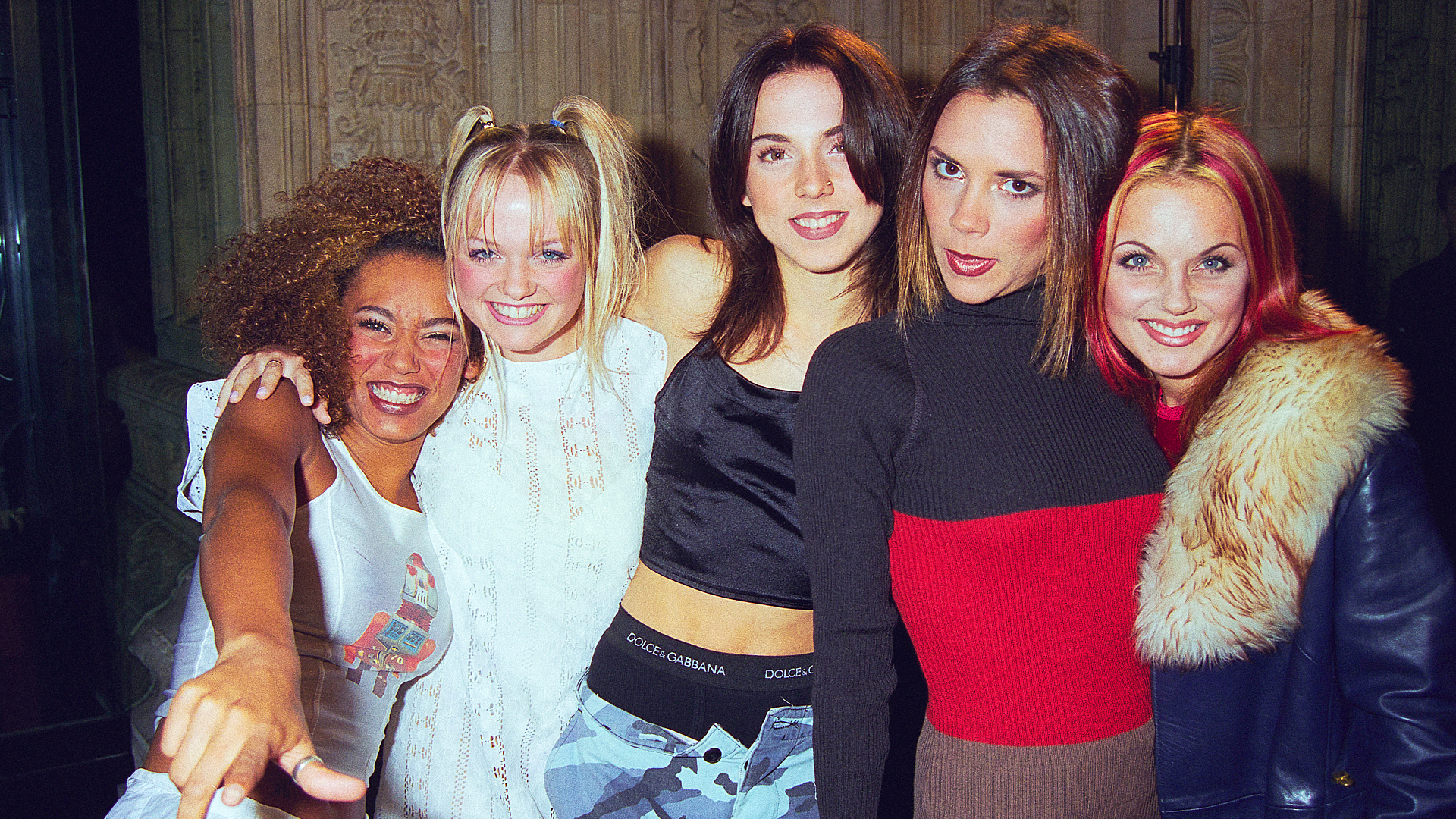
Although their cultural impact is sometimes understated, those who lived through the era remember that, from 1996 onwards, the Spice Girls were the dominant force in chart music. As Britpop lost its momentum, Sporty, Posh, Ginger, Scary and Baby Spice reminded millions of the joyful, life-affirming fun of pop.
But what some might have perceived as a carefully planned phenomenon was no contrivance. Without a series of tough decisions from the five, the Spice Girls might have been nothing more than a half-forgotten name, lost in an ocean of underperforming ‘90s pop acts.
Initially though, the assembly of the group that would become the Spice Girls was, in fact, entirely directed by the father-and-son management team of Bob and Chris Herbert.
Their company, Heart Management, was looking for a troupe of girls that could go toe-to-toe with the seemingly endless slew of boy bands that appeared to be popping up out of the ground every other week.
“At the time, boy bands saturated the market. The formula worked. Dad and our backer wanted to go down that route, but I wanted to reverse it,” Chris told Clic. “I thought a girl band – sassy, sexy and well put-together – could be more successful because it would appeal to female and male listeners. You’d double your audience.”
Uniformity wasn’t the objective. The Herberts planned to put together a team of girls that would each have a distinctive, standalone character and thus intrigue different sections of the market.
Eventually, after upwards of 400 hopefuls tried out for a place, the final selection of Geri Halliwell, Victoria Adams, Melanie Brown and Melanie Chisholm was locked in. Emma Bunton would replace the team’s initial pick of Michelle Stephenson as the fifth and final member.
Originally called Touch, the group would later be rechristened as Spice and then, eventually, the Spice Girls.
The five girls were all in. Moving in together to a three-bedroom house in Maidenhead just outside of London, the soon-to-be Spice Girls spent every day learning and revising a roster of pre-prepared songs and tightening up their dance routines.
Crucially though, the house-share forged an unbreakable friendship.
Being the oldest, Geri soon became the head of the household…
“[It] was lots of fun, albeit at times tricky,” Geri told Marie Claire. “I was the oldest at 22 and had already experienced living away from home, so the other girls probably found me to be quite bossy. Emma was the youngest at 18; she was like the little sister I never had, and I adored her immediately. Mel B and I became partners in crime, always getting into trouble together. Victoria and I had an equal, quite adult relationship. And Melanie C and I shared a childlike fascination for pop music and had big dreams of making it.”
Out of everything, it was this bond that was the most important outcome of the girls' time living together. They soon realised that their collective strength was more than a mere marketing ploy. And so, a formidable decision-making machine was born.
Before long, the five girls seized the reins themselves, and began to dictate to their management what they wanted from them.
The road to Wannabe began when the girls pushed Heart to put on a showcase for the industry, in the hopes of securing a label contract and reeling in new songwriters.
The showcase was held at Shepherd’s Bush’s Nomis Studios in December 1994. Fortuitously, songwriter and producer Richard 'Biff' Stannard - then riding high after the success of his recently-penned Steam for East 17 - was also at Nomis that day for a scheduled meeting with Jason Donovan.
Catching wind of the showcase, and being intrigued by the chaotic energy of Melanie Brown (aka Scary Spice), he was lured into Spiceworld…
“When I got there I bumped into Chris Herbert who was the Spice Girls’ original manager,” Stannard told Music Week. “Next thing I know, Mel B was there, like, ‘Who are you?’ and she jumped on my back, and that was it! I mentioned I’d done Steam and the girls all sang it, dragged me into a room and did a three-song set just for me [Laughs]. It was love at first sight. As a gay man, too, what I saw in them wasn’t sexual, which I think was refreshing for them.”
Stannard was besotted by the Spice Girls, and rushed to tell his songwriting partner Matt Rowe that he had landed their dream project. The girls were promptly invited to Stannard and Rowe’s studio at London’s Strongroom to start working on new material. It was here that the group’s explosive first single was penned.
The first song the group worked on was the R&B-leaning Feed Your Love. However, the girls began to feel that the track was too adult in tone to serve as their launch single. Biff would have to bring something fresher to the table…
Stannard had noted the girls’ fierce and unashamed confidence. After all, it was one of the very things that had sold them to him in the first place. Watching them closely across the three-day writing session, he began to understand that their friendship was core to what the Spice Girls were.
The launch single, he concluded, should express the unstoppable power of the five when united.
“I think the only pre-planned thing with Wannabe was wanting to represent them as a band as well as the essence of what they were: that fearless, headstrong, fantastically intimidating essence,” Stannard told The Telegraph. “They were outspoken, right from the start.”
With this in mind, Rowe and Stannard conjured a backing track to try something out with. With a relatively straightforward chord sequence in B major, a staccato, Summer Nights-inspired central piano riff was built atop a 110bpm drum loop sequenced on Matt’s Akai MPC3000. Presented to the girls, they were given carte blanche to work out their respective lyrics and vocal melodies.
“They made all these different bits up,” Rowe told David Sinclair for his 2004 biography Wannabe. “Not thinking in terms of chorus, bridge or what was going to go where - just coming up with all these sections of chanting and rapping and singing. And then we just sewed it together. Kind of a cut-and-paste method.” By all accounts, the writing of Wannabe's lyrics took under 30 minutes.
Wasting no time at all, Wannabe kicked off with the abrasively infectious ‘I’ll tell you what I want, what I really, really want’ section, welded to the jaunty riff. This tight, groove-driven intro then blossomed into the verse. A relatively stripped-back arrangement allowed the spotlight to be firmly held on the girls themselves.
As well as specifically introducing the five’s personalities and attitudes, the song expressed strongly the broader value of friendship over romance. The chorus stated directly to a prospective partner that their friendship was more important - and was something that no boy could get in the way of…
If you wanna be my lover, you gotta get with my friends
Make it last forever, friendship never ends
If you wanna be my lover, you have got to give
Taking is too easy, but that's the way it is
As a song, Wannabe did two things: it cemented that the Spice Girls were essentially a five-headed hydra – they were a singular entity that was, almost paradoxically, made up of unique but inseparable individuals. On top of that, the song had a message that would resonate strongly with children.
While the more teenage-angled end of pop and R&B was often too complex and perhaps too sexually-charged, 8-year-old girls (and boys!) could directly relate to Wannabe's straightforward expression of the value of friendship. After all, for kids, having loyal friends was the most important thing in the world.
It was also confidently female, and the very opposite of submissive. Here were five girls demanding prospective partners meet their requirements. The Spice Girls' adoption of the feminist slogan of 'Girl Power' as a central mantra (which the world would become very familiar with over the next few years) was imbued within the lyric.
As the song neared its conclusion, Mel B devised a rap which directly introduced the Spice Girls’ particular quirks and focused the lens of the song’s bigger theme directly onto this friendship group…