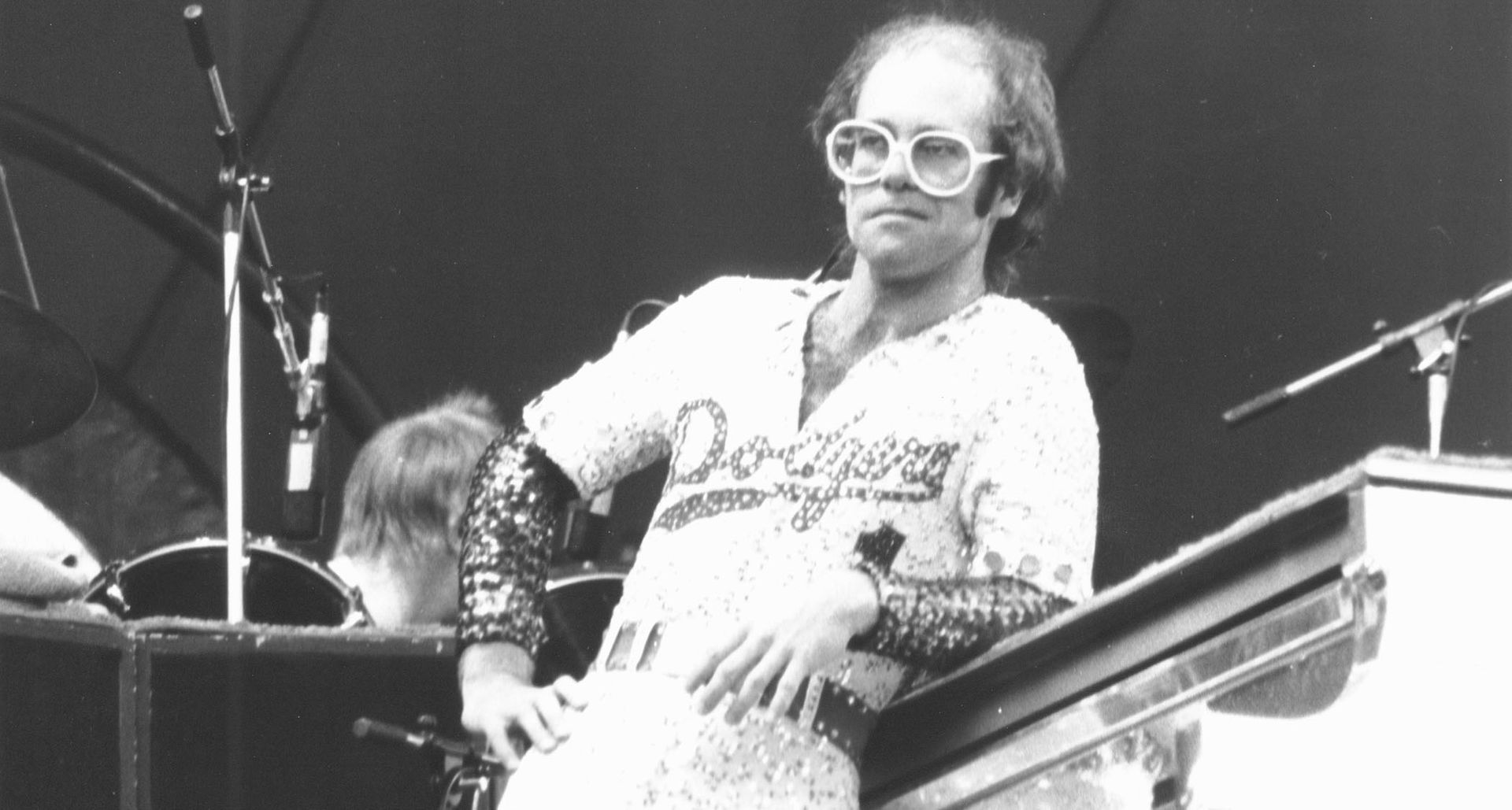
It was the best of times, it was the best of times. Truly. Spirits were high on the Starship as the Elton John Band were awaiting take-off, literally and figuratively.
It was the fall of 1974. Captain Fantastic And The Brown Dirt Cowboy had been recorded over the summer at Caribou Ranch, Colorado, scheduled for release the following May. This audacious, high-concept roman-à-clef told the story of Elton John and his lyricist Bernie Taupin’s friendship and collaboration, their rise from nowhere to everywhere. It was special and they knew it. They all knew it.
Elton John was already the biggest rock act of the 1970s. He was Captain Fantastic, Taupin the Brown Dirt Cowboy, and this was their story in song. The sessions also saw the Elton John Band track non-album singles and future classics Philadelphia Freedom and Lucy In The Sky With Diamonds, their Beatles cover going one better than anyone else by actually featuring a former Beatle, John Lennon. But all this could wait.
The Starship was the Elton John Band’s own private jet and it was headed to Dallas, Texas, for the opening show in their North American Tour. Caribou, Elton’s eighth studio album, had been launched in June and the record-buying public could not get enough of it. This was the Elton John Band’s biggest US tour yet, John’s eighth jaunt across the States in just four years. Davey Johnstone, the band’s guitarist and long-standing musical director, can remember it as if it were yesterday.
“We went back to LA after Caribou for about a week and got ourselves together, and then started the massive, iconic tour,” says Johnstone, joining MusicRadar over Zoom. “We were on the plane, on the Starship, all excited and having fun.”
If younger readers need a visual for understanding just how big Elton John was in 1974, then the Starship is as good as any. This heavily modified Boeing 720 had a red-white-and-blue paint job with white stars on a blue undercarriage, “ELTON JOHN BAND TOUR 1974” painted on the side. Inside, there was a fake open fireplace, a 15-foot bar trimmed with brass and a Thomas electric organ. There was a Club Room with plush maroon carpets, a divan, swivel chairs and a TV. You could also watch movies in the Gallery.
The Starship’s flight plan often read like who’s who of ‘70s pop culture. Cher and Elizabeth Taylor flew on it. Led Zeppelin flew on it, as did Alice Cooper, Peter Frampton and Deep Purple. Elton John often roller-skated down the aisle. Drummer Nigel Olsson liked to slide down the aisle and into the bar, and you can be sure that bartender John Ross kept it well-stocked.
That day, Kiki Dee, the opening act and later John’s partner on Don’t Go Breaking My Heart, had just boarded. “Kiki Dee was there, and we were all having a lot of fun there,” says Johnstone. “Bernie, everybody was there.”
The flight from LAX to Dallas was a party flight. Onboard was Dee’s band, the Muscle Shoals Horns, wives, girlfriends, and crew. Elton John was master of ceremonies in a white safari suit and a boater hat, star-shaped sunglasses, brandishing a cane.
But bad news arrived.
“It was kind of a damper because we were on the plane and we heard that Robbie McIntosh from the Average White Band had passed away,” says Johnstone. “It was such a shock to us, because it was one of those moments where a young guy [died], brilliant drummer, and we loved the Average White Band, obviously. Hamish [Stuart, AWB co-founder] is a good friend of mine to this day. It was so tragic to hear about that.”
McIntosh’s death hit them hard. He had taken what he thought was cocaine but it was heroin laced with morphine. The tragedy remains fresh in Johnstone’s mind. This was still an uncommon occurrence.
“It was one of those things. It’s almost like how much has changed, now we’ve got fentanyl, it’s killing people, and killed quite a few rock stars in the last 10 years or whatever,” says Johnstone. “That was the first glimpse we got of somebody getting a dodgy supply of whatever it was he did, and dying from it. So it was a damper on the tour at that point.”
The tour, however, was an unconditional success. Fans queued overnight for tickets. Venues were packed. The set was so strong and yet they still had all those Captain Fantastic tracks in reserve. The band did take the opportunity to play Lucy In The Sky With Diamonds; that always went down well.
But it went over especially well during their Thanksgiving performance at Madison Square Garden when John Lennon joined them onstage. Lennon and the Elton John Band took the opportunity to perform I Saw Her Standing There and Whatever Gets You Thru The Night, before returning for the show-closing encore of The Bitch Is Back.
Lennon was there having lost a bet that Whatever Gets You Thru The Night wouldn’t go to number one (it did), but he had been an early champion of Elton John anyway, and was a friend of the band.
When the Elton John Band took the cruise across the Atlantic to New York in lieu of the Captain Fantastic sessions, Cynthia Lennon had entrusted them to look after Julian before handing him over to his father, John.
“He thought that we were the best stuff that he had heard since the Beatles,” says Johnstone. “And for us to hear that from John Lennon was like, ‘What?’ It was a wonderful compliment.”
There was a touch of serendipity about how Lennon ended up recording Lucy In The Sky With Diamonds. They knew Lennon intended to visit Caribou Ranch for a week during the Captain Fantastic sessions. But nobody was sure exactly when. Lennon wanted to see how the band worked.
The story of Elton John's Lucy In The Sky With Diamonds cover tells us a lot about what that was like to play in the band. Johnstone often found himself in the studio with John, Olsson, bassist Dee Murray, and he would often play around with the song.
“During the odd session when Elton and I, and Dee and Nigel were together, one of the things that I would do is I would start playing the riff from Lucy In The Sky With Diamonds,” he says. “It was just one of those things, and it was like, ‘Oh, we must record that one day.’ Well, when John came up, it was a no-brainer. I started playing that in the studio, it was like, ‘Let’s do that!’”
Captain Fantastic And The Brown Dirt Cowboy went gold before its release and stayed at number one for seven weeks. It was all systems go. But there was change in the camp. A month before the album was released, John wanted to shake up the pack. Olsson and Murray were out. Roger Pope joined on drums, Kenny Passarelli on bass. Caleb Quaye rejoined on guitar, while James Newton Howard was hired as keys player.
As band leader and musical director, Johnstone helped assemble the new band. Although he appreciated the responsibility, it was not an easy task. He was close to Murray and Olsson.
“All that transition – I’ve got to be honest – it was difficult for me because suddenly I was thrust into that situation of being band leader, music director,” he says. “Before, it was just four or the five of us, and now it was all these other guys.”
Captain Fantastic had been out for four weeks. This new band had only been together since April, and yet on June 22, 1975, they were scheduled to make their live debut together at Wembley Stadium, performing the album in its entirety. Jeff ‘Skunk’ Baxter, then of the Doobie Brothers, joined them as a guest guitarist. It was a true baptism of fire. Johnstone lets out a hearty laugh at the memory.
“Yeah, it’s funny, because we always note to this day that it was just, like, ‘Really!? We played the whole of that album and it wasn’t even out?’ Or maybe it was just out,” he says. “You know? Like, why did we do that? We would laugh about it now and go like, ‘Fuck no!’”